
MVP development for
a first release people can use.
We agree what the first version has to prove, cut the scope to that and build it as working software.
Client project · MVP delivered · AI agent platform MVP
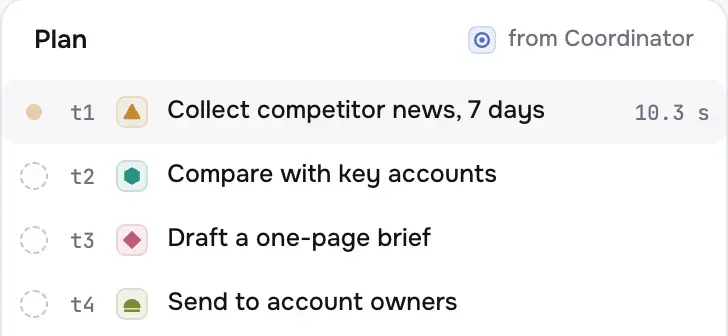
In this tour
Choose a moment to hold the tour on it.
AI agent platform MVP
We designed the architecture and built the first release: an agent builder, a coordinator with hand-offs, a shared memory, guardrails, a model router and Stripe plans with limits.
Read the case2 monthsThis project, from brief to a working MVP
$3MRaised by the startup since the MVP was delivered
Before the first feature
What version one has to prove
The core task works
One user gets from start to result without someone from your team stepping in.
The hard part holds up
Cited answers, agents acting on real systems or data that must be right, tested on real material.
It is safe to let people in
Each person sees only what they may see, with safeguards against misuse.
How we cut the scope
One board decides the first release
Must is the first release. Everything else waits or is dropped, with its reason on the card. Tap a card to see why.
Must4
In the first release
Why it is inEvery screen after sign-in needs to know who the user is and what they may see. Both are hard to add later.
Why it is inThe first release has to prove that people can finish this task.
Why it is inThe core task cannot run without this data.
Why it is inPayment from day one shows whether people will pay. The plan's limits protect your costs.
Fixed price covers MustThe first release
Next3
First in line for version two
Why it waitsIn this example one person can finish the task alone. Invites follow once people keep coming back.
Why it waitsSign-in emails come with accounts. Real use shows which other emails help.
Why it waitsIt needs real usage before it shows anything worth reading.
Later3
When the evidence is there
Why it waitsWeb comes first in this example. A native app follows if the task moves to the phone.
Why it waitsLarger customers tend to ask for it when they buy, usually after the first release.
Why it waitsOnce other people's code depends on an API, its shape is hard to change. It waits until the data has settled.
After launch, version two starts from NextEarly use shows which cards come first.
What goes into a first release
Key journeys
Screens for the core task, with the first-use, empty and error states a demo often skips, designed next to the engineers who build them.
Working software
Front end, back end and data model for the agreed scope, with the integrations the core task needs. On the web, or on a phone if that is where the task happens.
Controls from day one
Sign-in, roles and safeguards against misuse, plus plan limits if you charge, scoped to the core task and tested like any other feature.
How an MVP project runs
From first conversation to first users
Five steps, each ending in something you review and a decision you make.
See the full processDiscovery
We talk through who the product is for, the task it helps them finish and what version one has to prove to first users, a pilot customer, investors or yourselves. An idea and a few conversations are enough to begin.
What you get
- The core task and who it is for
- What version one has to prove
- The riskiest assumptions
You decide
Whether to scope it together
Cut the scope
Every feature goes on the board as Must, Next or Later, or is dropped, with a reason on each card. Must holds only the core task and the controls it cannot go live without. If a date is set, Must is cut to fit the window.
What you get
- A scope board with a reason on every card
- Acceptance examples for Must
- A planned timeline and a fixed price for Must
You decide
Approve Must and its price
Design and foundations
Key screens for the core task, plus an architecture and data model chosen so that version two extends version one instead of replacing it.
What you get
- User flows and key screens
- Architecture and data model
- Integration and release approach
You decide
Approve the approach
Build by milestone
Development moves in short milestones, each ending in something you can try in a test environment. The code is checked against the acceptance examples before delivery.
What you get
- Working increments in a test environment
- A review at each milestone
- Test results against the acceptance examples
You decide
Accept each milestone
Release and handover
We release to your first users and hand over the code, design files and documentation.
What you get
- Release to your first users
- Code, design files and documentation
- The version two backlog
You decide
Continue with us or take over
What stays with your team
Built with us.
Yours to keep.
You bring a decision owner who settles scope questions quickly, and someone who knows your users and joins the reviews.
01 / Yours
The code and design files
You own them, in your accounts, with access from day one.
CodeDesign files
02 / Yours
Documentation
Handed over with the code, to support future development, so your engineers or another partner can carry on.
DocsPart of the handover
03 / After handover
30 days of bug fixes
For 30 days after handover, we fix bugs within the delivered, agreed scope at no extra cost.
Within the delivered scopeOngoing support can be arranged
Your first release.
Let’s scope it.
Tell us who it is for, what the first version has to prove and any date you are working toward.
Frequently Asked Questions
Our base MVP range is $24,000–45,000 USD for one core workflow, including design, development and QA. Additional roles, integrations, AI features or payments are priced separately. The AI agent platform above had its own project scope. We agree a fixed price for your release, and you approve any additional work before it starts. See package details and estimate your project.
The timeline is planned together with the scope. If a date is already set, such as an investor meeting or a pilot, the window is agreed first and the first release is cut to fit it. As one reference point, the AI agent platform MVP took two months from brief to a working MVP. That was the timeline for that product's scope, not a standard length for every MVP.
Only if the open question is one a prototype or proof of concept answers. A prototype tests whether people understand the flow and want the product, with clickable screens and no real data behind them. A proof of concept tests whether one hard part can be done at all. An MVP tests whether people will use the product: working software for the core task, with real accounts and data. Discovery shows which one you need first.
Yes. A detailed brief is not required. Tell us who the product is for, what it should help them do and any date you are working toward. Discovery and scoping turn that into a written scope before anything is built, and then you decide whether to go ahead.
The aim is for version two to extend version one, not replace it. We keep the scope small and the foundations sound: an architecture and data model chosen for the product you expect to grow into, code reviewed by senior engineers and documentation from the start. When the product grows to serve many customers on several plans, SaaS development takes it from there.
Yes. The AI agent platform is one: AI agents that share a memory, with guardrails and a model router across OpenAI, Anthropic and open-source models. We agree external services and data access upfront, exclude your data from AI provider training, and support hosting within your infrastructure.
You own the code and design files, with access from day one. Documentation is part of the handover, so your engineers or another partner can carry on from where we stop. We can also keep working alongside your team on the next releases.
For 30 days after handover, we fix bugs within the delivered, agreed scope at no extra cost. Early use then shows which items to bring forward for version two. Further development can be arranged, including a product design pass on what early users found hard.